
Is ChatGPT A Search Engine?
What This Shift Means for SEO Strategy and Technical Planning
Posted by Charlie Recksieck
on 2026-02-26
But are ChatGPT, voice assistants and other search methods reducing the importance of Google for finding answers and changing what websites need to do for SEO? Yes!
How Do Voice Assistants And A.I. Differ From Google?
ChatGPT and similar AI chatbots provide direct explanations without requiring users to click multiple links.
Google traditionally returns lists of links for the user to click and then go read on another page.
Users increasingly turn to AI for complex queries or guidance, rather than typing keywords into Google and scanning results.
Other Sites You Don't Think Of As Search Engines
In the pure "search engine" market, Google has stepped on the throat of Yahoo and become one of the most dominant companies on the planet. Google performs 85-88% of the online text searches in the U.S.
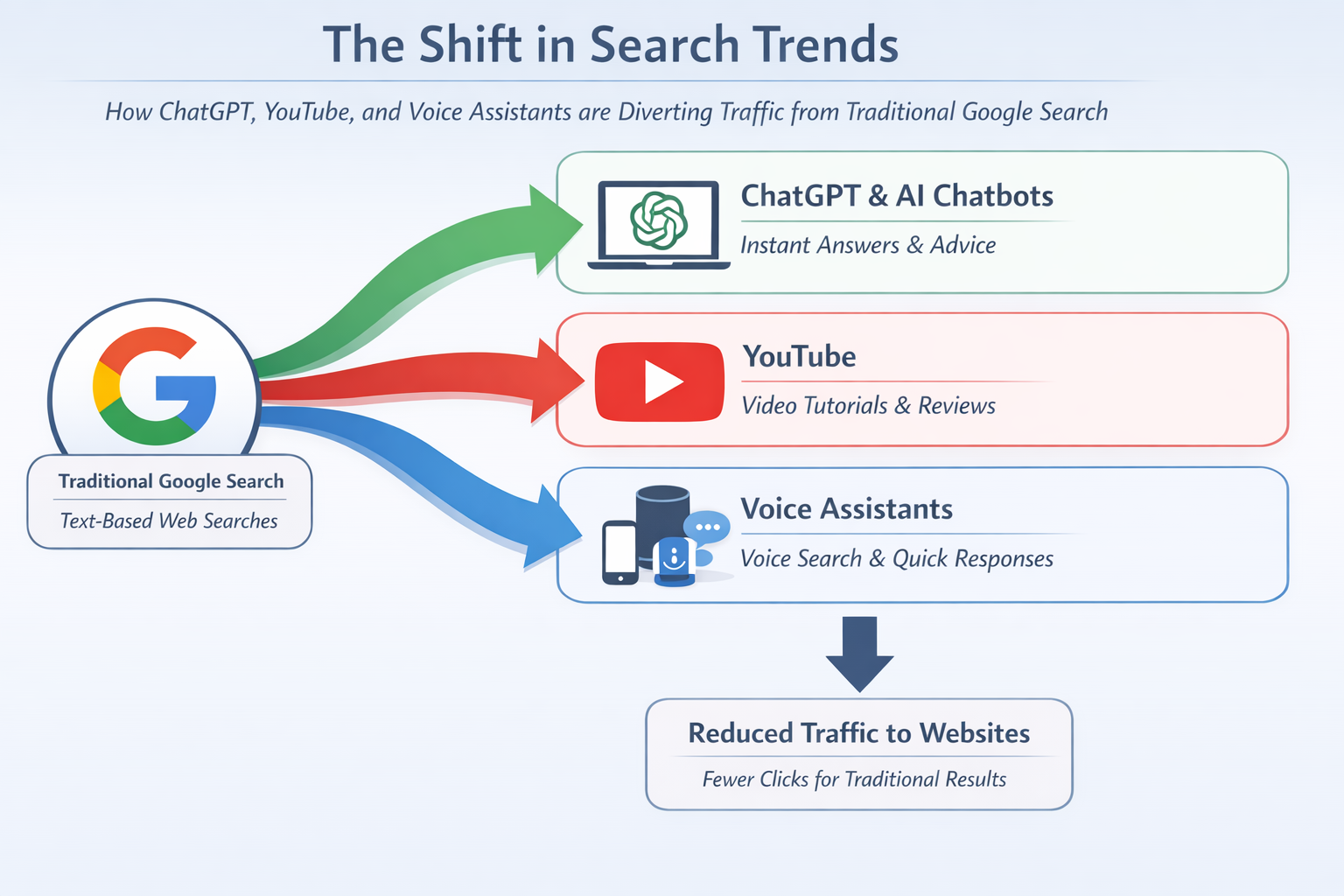
But if we expand searches to reflect any site where people go and type something into a search box, then we should be considering YouTube, Reddit, Wikipedia and other sites that give internal information instead of returning a list of external links.

How does this reflect a new environment?: Instead of googling "how to fix an icemaker" people type it on YouTube and skip the search engine step entirely.
By the way, don't cry for Google over those YouTube searches; Google owns YouTube.
Voice Assistants (Siri, Alexa, Google Assistant, Cortana)
The usage numbers on voice assistants don't approach the amount of daily searches on Google. For now. But that surely will change. Voice assistance adoption and acceptance is continuing to grow. Cars will be equipped with voice search.
Voice search only returns one answer, unlike old-fashioned Google search with multiple links.
What Alexa and Siri are looking for from sites is different than how Google does it. They need an authoritative answer. As long as the result is honest - and the top spot isn't biased by advertising dollars or strategic partners - then any "SEO" strategy for voice should center on your site being seen as THE authority.
A.I. And ChatGPT's Approach
As you can probably guess, ChatGPT puts more intelligence and calculation into their results than a voice assistant like Siri.
ChatGPT is building on its own massive datasets and language-learning model to figure out user intent. Something like Cortana is a little more mechanical. Whereas ChatGPT is really looking for authoritative answers to the questions they "think" you're asking.

People Want Answers, Not Links
Old traditional search engines would take a subject and then return a series of links hopefully most likely to give an answer. But ChatGPT cuts out the middleman and can take a conversational question and return a conversational answer.
SEO success is no longer just trying to get pageviews. Success with ChatGPT might end up being just quoted, summarized, or cited. If you knock it out of the park, then your site can become the default source an AI trusts.
Heads-up to web designers or content providers: Providing information no longer means that people are on your site where you can sell them your goods or services. Ouch.
How Should Your SEO Strategy Adapt
Since SEO is shifting from ranking pages to being the source of answers.
Your new goal is being an authority. So, if you have one post on a subject, let's say pickleball, great. But if your site features ten interconnected posts on pickleball, then you're more likely to be an authority.
Guess what also works? Lists. So, I guess Buzzfeed is ahead of the curve with their listicles.

How Should Your Content Actually Change
The key for this kind of "authority" content is to be easy for ChatGPT to extract your main points from.
What works best is a lot of structure:
- Short paragraphs
- Bulleted lists
- Tables
- Clear headers - usually as questions like:
** "What is ..."
** "Why it matters"
** "How to fix it"
- Bulleted lists
- Tables
- Clear headers - usually as questions like:
** "What is ..."
** "Why it matters"
** "How to fix it"
Since voice assistants demand short, natural answers - lots of one-sentence summaries should do well. Answering "who / what / when / why / how" is a tipoff to ChatGPT that you're answering useful questions.
How Do People Hear About You If Asking Questions To ChatGPT
Here's the new paradigm for your content being found:
Old SEO:
"How do I rank for this keyword?"
New SEO:
"How do I become the best possible answer - even if no one clicks?"
But does being mentioned on an Alexa answer or ChatGPT results get your visits or, more importantly, any business? I'm not so sure.
If you are the Siri result authority, there isn't much guarantee that Siri reading your solution will translate to sales.
For immediate leads or website visits, you still need your Google results game to be strong:
- Google SEO
- Paid search / social
- Email or retargeting campaigns
- Paid search / social
- Email or retargeting campaigns
How Is This Going To Change Content
The good news is that it's going to get rid of fluff in articles that are there entirely to game the old Google SEO system but do nothing for the user. Case in point: Recipe sites usually make you scroll through screens and screens worth of crud like "Where Was Lasagna Invented" and "Why Does Italian Food Taste So Good" to show phone user-engagement (i.e. scrolling) when you're just trying to find a lasagna recipe.
On the other hand, my suspicious old-guy brain wonders what's going to happen to language. Internet culture has already sped everything up and diminished our attention spans.
But now if proper SEO for A.I. and voice search rewards canned headings, simple language and short answers, then the actual quality of writing is bound to get worse. We're rewarding simplicity and penalizing complexity. \
I know that I should have said that with bullet points and sub-headings. But I didn't want to.
What Does This Mean For Your Site?
You won't out-rank Amazon or Wikipedia, but you can become a trusted source in a very narrow niche.
I’ve got a music site for my side career of musician. It would be stupid and pointless for me to market that music as "great indie band" or "singer songwriter." Those fields are way too crowded and that content won’t get anywhere. But if I focus on songs sounding like Randy Newman with a pithy tagline of "the stupid man’s Randy Newman" and feature multiple posts about Randy Newman and my music that link to each other, then I have a much better chance of being prominent in a specific niche. It positions me to be the returned result for "other music I’d like if I like Randy Newman."
On your site make sure that you’re working to dominate your niche. Whether it’s "divorce lawyer in Tucson" or "factory maintenance software." Remember these two general watchwords:
Local, specific, experience-based content wins
Authority beats volume
Authority beats volume
