Social Media for Small Tech Teams: How to Be Effective Without Burning Out
A Lightweight Process Approach for Small Teams
Posted by Charlie Recksieck
on 2026-03-19
That means that social media duties fall on somebody with other full-time responsibilities. Those duties probably feel like "one more job" for the person or people assigned.
There's some good news for you: Effective social media presence doesn't require constant effort or even daily posting.
With some good systems in place and a few minutes of focus per week you can thrive on social media AND not burn out.
Why Social Media Feels So Exhausting
In small businesses and solo side-hustles, there are a lot of challenges. There never seems to be enough time to go around. When it comes to social media, workers might wonder if it's worth the effort and not prioritize spending marketing time when there's so much work to get out the door.
With that pressure, people charged with social media responsibilities might worry about what content they have to produce and wonder if there's a decent "return on investment" of time spent.
The feeling of burnout can be exacerbated by a scattershot approach leading to doubt at social media value. I propose that if you can get an effective system in place for your social media, it not only won't feel like a waste of time, but you will see positive results.
Start Small: Fewer Platforms And Low Commitment At First
Don't bite off more than you can effectively chew. The most important decision for social media is which platform(s) you should be on. Just one or two platforms is plenty.
Each social media app has its own demographic and purpose. Choose the one that relates to your business.
LinkedIn - Good for professional services and business-to-business leads.
You can think of LinkedIn as the place people go to find a new job, but there are plenty of knowledge-sharing opportunities there and, better yet, recommendations of service providers.
Instagram - Good for reaching the general public and brand visibility. Photo and video focused. If you're selling something that people eat, read or use, it's a good place to start.
X/Twitter - Good for commentary or industry. it really isn't what it used to be since 2023 changes, but no similar site has replaced the once-great size of its community. It is, or at least was, a great place for commentary; reporters and writers thrived there.
Facebook - Good for almost everything. It skews a little older than Instagram or TikTok. Your business' page there is an easy place to post. And their ad targeting really is remarkable.
Pinterest - Good for design, fashion and food. Very visual medium. Probably not a place for B2B or writers, but if somebody is running a DIY-craft or wedding-planner business, it's a must.
Instagram - Good for reaching the general public and brand visibility. Photo and video focused. If you're selling something that people eat, read or use, it's a good place to start.
X/Twitter - Good for commentary or industry. it really isn't what it used to be since 2023 changes, but no similar site has replaced the once-great size of its community. It is, or at least was, a great place for commentary; reporters and writers thrived there.
Facebook - Good for almost everything. It skews a little older than Instagram or TikTok. Your business' page there is an easy place to post. And their ad targeting really is remarkable.
Pinterest - Good for design, fashion and food. Very visual medium. Probably not a place for B2B or writers, but if somebody is running a DIY-craft or wedding-planner business, it's a must.
At least for us at Plannedscape, we schedule regularly on LinkedIn and Facebook; those two make sense in our case since B2B content makes sense, and our target audience fits a Facebook demographic. We also have started up on Instagram as well just for a little extra visibility although there's not much time spent there.
How Often To Post?: Don't be overwhelmed by having to "feed the beast" every day. Consistency matters more than frequency. But here's some good rules of thumb:
LinkedIn: weekly
Facebook: 1-2x/week
X/Twitter and Instagram: daily or near-daily (if used)
Facebook: 1-2x/week
X/Twitter and Instagram: daily or near-daily (if used)
For those of you here related to tech, a thoughtful weekly share or update is just fine.
What To Post - Turn Existing Work Into Content
Let's say you're part of a tech team. You might not exactly feel like an influencer. What do you post about?
You've already got content without knowing it: Your job. Project documentation, responses to client questions, blog posts, lots of things you already have would make for excellent posts.
If you're looking for basic post ideas:
- "A question we get from a client all the time"
- Your take on a relevant article you just read
- "One thing we solved this week"
- Photo of somebody on your team
- Your take on a relevant article you just read
- "One thing we solved this week"
- Photo of somebody on your team
Just translate some things at work and you've got plenty.
In our case we already write this weekly blog, so it gives plenty of grist for the social media mill. Not just during the week of a post, but we can always revisit an old article and especially if there's something newsworthy or recently relevant about it.
Use Automation (Without Losing Your Voice)
Despite having some content ideas, you might feel like social media posting requires constant attention on your part. It doesn't. There are some incredible free or low-cost scheduling tools for you.
Social Media Management Apps: Hootsuite, Buffer, Zoho, Sprout Social, Later
Using something like Buffer can take care of your entire social media calendar. We use it to schedule our posts to LinkedIn and Facebook. We spend maybe an hour a month on post management total; click two apps on the scheduled post in your Hootsuite calendar and it goes to multiple platforms.
And if you post to Instagram, it can post immediately also to Facebook. A definite time-saver.
Let's take the helpful applications to the next level, use AI!
AI Helps With
- Caption drafts - just feed it a photo
- Generating SEO friendly keywords - send a draft of the post and ask it for keywords
- Generating SEO friendly keywords - send a draft of the post and ask it for keywords
Use these tools together and this all gets easy.
Defining "Success"
Like in any other endeavor, having a goal is a great way to get somewhere. For better or worse, social media has plenty of metrics that let you measure how well you're doing.
Social Media Goals - And Measurements:
Visibility/Relevance - Several platforms show how many impressions your post got.
It's not all because of how many followers you have; many platforms put your post in front of people if it seems relevant.
Engagement - How many people are commenting. Likes are easy, but real engagement is where it's at.
Occasional Inbound Leads - Clicks to your website; web stats trackers like Google Analytics have great sections of rich data about social media fueled clicks to your site.
Engagement - How many people are commenting. Likes are easy, but real engagement is where it's at.
Occasional Inbound Leads - Clicks to your website; web stats trackers like Google Analytics have great sections of rich data about social media fueled clicks to your site.
Advice: Don't get caught up in the number of followers you have. Yes, if you have 10 followers, your chances of having your message spread around get a lot slimmer. But we've seen Instagram accounts with 30,000 followers get little engagement while ones with just 300 followers start meaningful conversations.
We worked with a law firm client on their website and their social media strategy. And in the first 6 months we didn't see their follower numbers climb that much - but they got 2 new clients that were confirmed to come to them from social media. Two clients more than made up for any time and advertising budget spent, and then some. They are converts to social media, for sure.
As somebody once said, "A goal without a plan is just a wish." So, set yourself some simple metrics goals, X number of comments in the next 3 months, 5 website clicks by a certain date.
Sustainable Beats Viral
Social media is a marathon, not a sprint. But that doesn't mean that it needs to be a grind. Use some of these tools we described.
Regularity: Consistency is the key. I can't tell you how many websites we've helped with that have a well-intentioned weekly blog that dies out. In their case, I recommend posting monthly instead of weekly. Whatever your schedule is, stick to it.
Start small with your goals and your schedule. Like we mentioned above, you already have plenty of professional content just from doing your job.
I'll leave you with one last suggestion: Inject a little of your personality in your posts. You might be leery of posting your photo and making it all about you, but people really do respond to other people. You don't have to make yourself a "brand" but let people see a little bit of who you are; they don't want robots in their daily work - they want to connect, too.
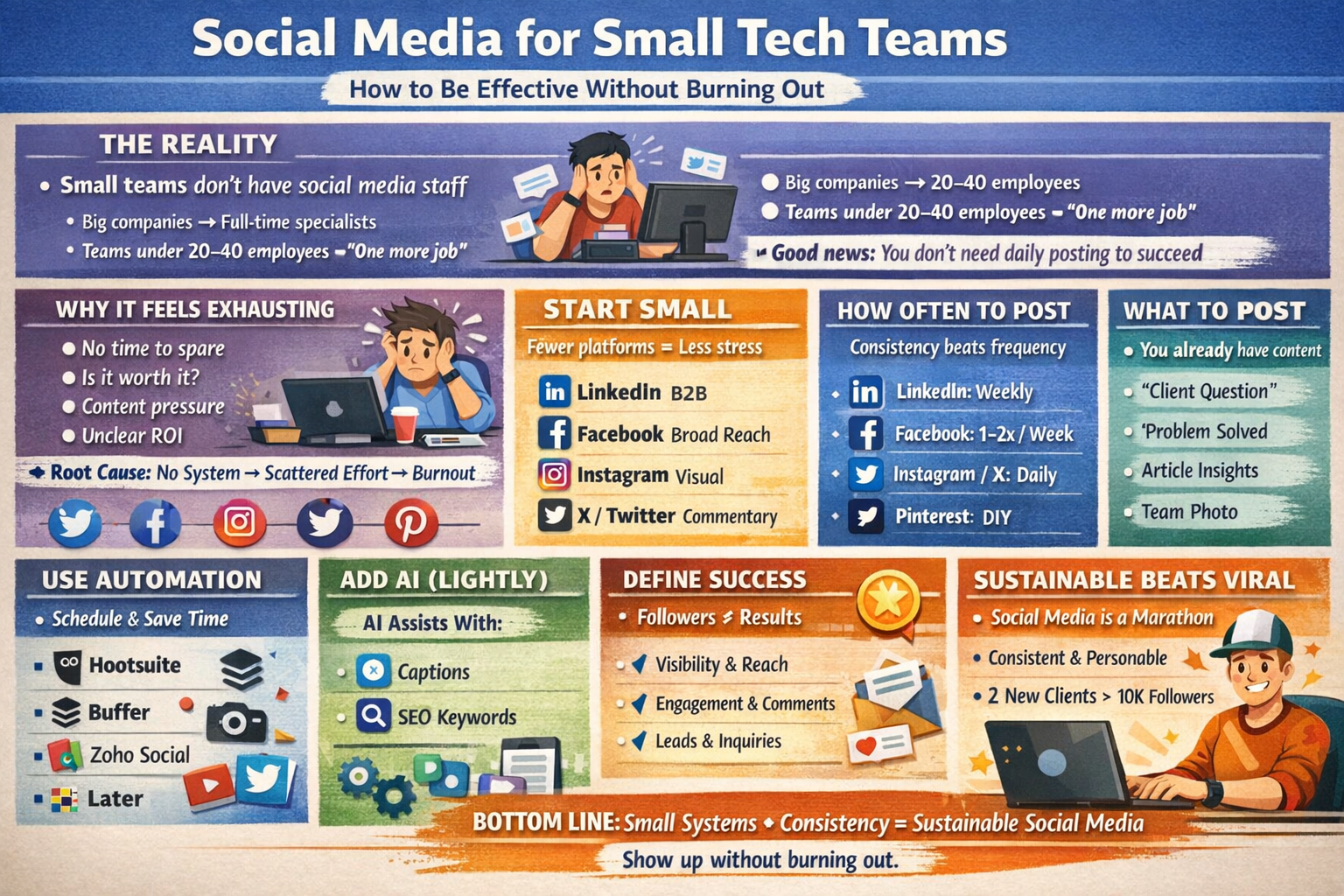
I’ll also leave you with a packed graphic of the salient points: