
Technically Predictions
How Did Futurists Do with the Future
Posted by Charlie Recksieck
on 2026-06-18
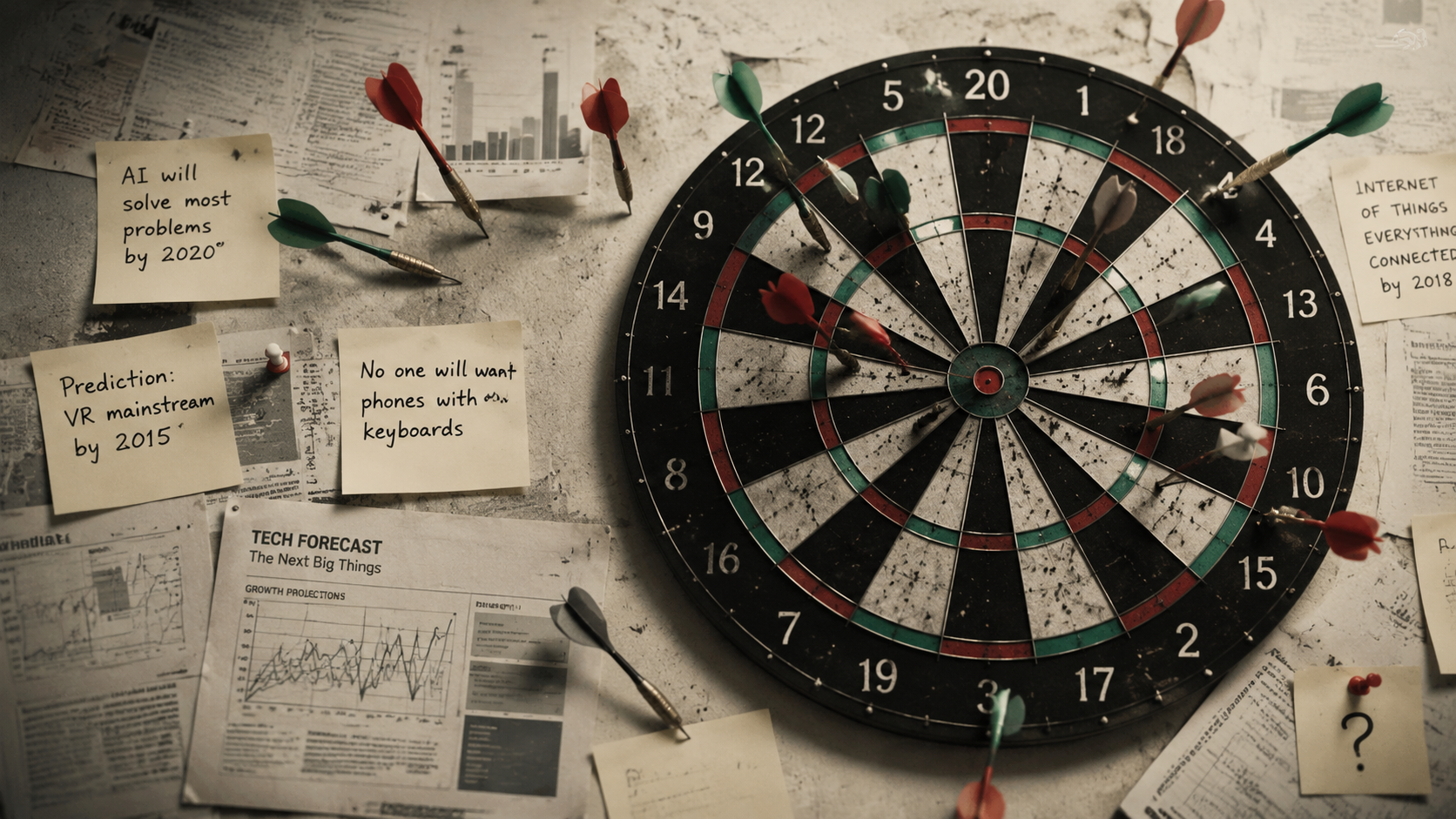
Computing and technology are especially prone to patting themselves on the back. Really, how hard is it in 2022 to say "AI is gonna be a big deal", or "the Internet is here to stay" in 1998.
Given all of that, I wanted to find some reputable tech "insiders" and writers old thoughts and see how they did. So here we go.
1990 Predictions
Steve Jobs
Source: Medium
1. Death of the Middle Manager
Claim: Kind of an implied claim. But Jobs predicted traditional management layers would collapse under software leverage.
Grade: F
Why: Corporate hierarchies expanded, not collapsed. Middle management didn't disappear, it multiplied in tech and enterprise orgs. Even AI-era companies still rely heavily on management layers
2. We are going to merge with technology
Claim: Humans will meaningfully merge with machines.
Grade: D
Why: Could be true eventually but I can predict the end of humans on earth and I’ll eventually be right. No widespread human-AI cognitive integration exists. And brain-computer interfaces remain experimental. No biological or cognitive merging is happening yet in any real sense.
3. Software will become omnipresent, intelligent, and adaptive
Claim: Software will deeply anticipate human needs and become personalized and intelligent.
Grade: B-
Why: "Anticipate needs" is still limited. Most systems are reactive, not truly adaptive intelligence. Recommendation systems improved (Netflix, YouTube, TikTok). Partially true in spirit, but overstated in capability.
4. Keyboards and wires will start to go away
Claim: Input devices like keyboards will largely disappear due to speech and wireless interfaces.
Grade: F
Why: Yeah, we’ve got voice input, but still secondary for most tasks. Look at your desk. Do you see a keyboard or some wires? That’s 36 years later so this was a big Steve Jobs whiff.
5. AI = 1000x productivity ? A/B player gap explosion
Claim: AI creates extreme productivity gaps, making mediocrity obsolete.
Grade: B-
Why: Yes, productivity differences exist, but not reliably 100x-1000x across roles. In some areas, AI hasn’t surpassed humans, even in best cases still requires oversight. But Jobs is so much closer to being right in 2026 than he would have been in 2023.
OVERALL: Was there any bigger over-promising technology evangelist than Steve Jobs? It shows in these predictions.
2000 Predictions
Wired Magazine
Source: Wired
1. The Internet Will Become Defined by Intellectual Property Wars
Claim: Large companies and lawyers would aggressively battle over digital ownership, copyrights, patents, and online content.
Grade: A-
Why: This might have seemed paranoid at the time. But let’s see: patent trolls, DMCA takedowns, piracy battles, AI training-data lawsuits. Yup, seems about right to me
2. Companies Will Outsource Their Web Infrastructure
Claim: Businesses would increasingly rely on third-party web services instead of running everything themselves.
Grade: A+
Why: Is there a grade above A? They didn’t predict the word "cloud" but got everything else right. A direct hit.
3. Mobile Wireless Computing and AI Personalization Will Replace Traditional Desktop Computing
Prediction:
Wireless devices, machine learning, and intelligent software assistants would personalize the internet and follow users everywhere.
Grade: A-
Why: The nailed smartphones, personalized feeds, recommendation algorithms and AI assistants. I don’t think desktops died as completely as they said and we still have keyboards. But good job.
4. Search Engines and Software Will Become Conversational and AI-Driven
Prediction:
Natural language processing and AI reasoning would reshape search and online interaction.
Grade: A
Why: ChatGPT, anybody? Instead of game-able SEO driving search results, we did indeed end up with conversational interfaces, AI-powered search, and question-answering systems. Not that I think AI is on a great search path in 2026.
5. The Dot-Com Bubble and Web Advertising Boom Would Collapse
Prediction:
Most internet startups would fail, and massive VC-fueled advertising spending would dry up.
Grade: A+
Why: Basically predicted the dot-com crash in real time. They called their shots with unsustainable startup spending, and only a handful of web companies surviving long term
OVERALL: Hats off to the team at WIRED for their targets and observations here. One little quibble: Some of these (mobile and dot-com bubble burst) were pretty damn easy at the time, lots of startups were already by the wayside. But let’s give credit where credit is due.
2005 Predictions
CNN
Source: CNN
1. Wireless mobile connectivity becomes the center of life
Claim: An "everything changes but looks normal" prediction.
Grade: B-
Why: Let’s not retroactively forget how much people were texting and emailing on Blackberry or Treo. And "the center of life" is a crazy way of putting it. But go camping without internet access this weekend to see how central it’s become to your life. Yeah, a correct prediction - but bold? [nope]
2. Fast, efficient websites will beat flashy design and branding
Claim: Speed and performance will determine success more than visual design or branding.
Grade: A-
Why:
This is a prediction that aged better than most flashy futurism. Flash websites that taxed your primitive internet connection in 2005 were already annoying. We just tolerated suffering because it was HD.
3. Biotechnology and genomics will revolutionize medicine
Claim: Genetic science and biotechnology will dramatically reshape healthcare and medicine.
Grade: B+
Why: Pretty correct on: genetic testing, biotech startups, mRNA breakthroughs. But the transformation arrived slower and less widely than many expected.
4. Energy-efficient consumer products will become socially important
Claim: CFL bulbs, low-flow devices. Consumers and governments will increasingly prioritize energy-efficient technologies.
Grade: B+
Why: Smart companies do watch their bottom line with LED lighting and efficiency standards. But "sustainability" didn’t market as well as they thought. And they never saw politics coming into the mix so heavily. Who could have?
5. Weather prediction technology will dramatically improve
Original framing: Computing advances will significantly improve weather forecasting and climate modeling.
Grade: B
Why: What’s your batting average in 2026 when looking at weather apps to help make decisions? Personally, mine is a little so-so.
OVERALL: The predictions and overly long list in the article is pretty weak sauce. I had to infer some predictions to make it more than a "technology is good" listicle.
2010 Predictions
MIT / Kurzweil
Source: MIT
1. Computers will disappear into the environment (ubiquitous computing)
Claim: Not just that we’ll have better computers, but that many things will become computers. Supposedly, sensors everywhere and smartphones as "always-on computing nodes".
Grade: A-
Why: To be fair, computing didn't disappear. It just got everywhere and stayed annoying. Originality credit: High, does NOT just repeat earlier "mobile internet" predictions. A-minus because the majority of computing is still done on computers.
2. Full-immersion AR/VR interfaces (retina-level computing)
Claim: Visual information will be projected directly into human perception via AR/VR systems.
Grade: B
Why:
They anticipated AR glasses, VR ecosystems like Oculus, spatial computing interfaces. A lot of it did get invented but they made it sound ubiquitous. I have still never talked face to face with somebody wearing Google glasses.
3. Human-machine "merging" will become a technological trajectory
Claim: Humans will increasingly integrate with machines, blurring biological and digital boundaries.
Grade: C+
Why: Brain-computer interface research, prosthetics + neural control systems - but this is classic Ray Kurzweil stuff. We are so far away from cyborg territory or being able to download a language to our brains in 2026.
4. Machine intelligence will exceed human cognitive capacity in raw computation
Claim: Machines will surpass human brains in computational power and analytical ability.
Grade: A-
Why: This is basically the foundation of compute-driven intelligence models and large-scale neural networks which they nailed. I bumped down to A-minus because I think they didn’t realize how fast some of this was going to occur.
5. $1,000 of computing power will exceed the human brain
Claim: Commodity computing will reach or exceed the raw processing capacity of the human brain.
Grade: B-
Why: Is intelligence the same as compute power? Nope. So yes, the point of computational power is more than humans can compute; but the same could be said of the calculator in 1965.
OVERALL: This is the only list that really annoyed me. It’s got Ray Kurzweil’s fingerprints over everything. He’s a brilliant guy and has been fairly correct as a futurist over the years. But I swear in the man vs. robot wars to come, he’s rooting for the robots. So my take is generally: F this guy.
2015 Predictions
Enterprisers’ Project
Source: Enterprisers’ Project
1. Remote work will become structurally normal
Claim: Work will shift from being tied to a physical office to being distributed, with remote teams becoming a standard operating model.
Grade: B+
Why: This is not just "people can work remotely." It predicts the structural shift in hiring geography. COVID makes this prediction look smarter than it was; this was pretty inevitable. I started working at home in 2004 and my productivity doubled.
2. 5G will accelerate IoT and edge computing, but increase attack surfaces
Claim: 5G rollout will enable widespread IoT/edge computing expansion while introducing new cybersecurity vulnerabilities.
Grade: A-
Why: It treats 5G as an architecture shift, not just speed improvement. So many predictions are about capability expansionm, but they also got into systemic risk expansion and knocked it out of the park.
3. Smaller cities will draw more tech HQs and startup activity
Claim: Tech companies and startups will increasingly relocate or expand outside major hubs like San Francisco and Seattle into smaller, lower-cost cities.
Grade: A-
Why: This is a counter-agglomeration prediction. Portland, Raleigh, Nashville, Pittsburgh, Salt Lake City mentioned as emerging hubs driven by cost pressure and talent distribution - but also very depending on #1 above, remote locations.
4. Quantum computing will advance in research but not reach practical application
Claim: Quantum computing will continue making progress but will not yet deliver real-world, production-grade use cases.
Grade: A
Why: My favorite prediction in this whole article. Every computing trend column from the past 20 years talks up the advances of quantum computing. These guys correctly separated "progress" from "utility". Bravo.
5. Platform governance will become a major public issue, but not translate into effective control
Claim: Large digital platforms will face growing political scrutiny and calls for regulation, but actual governance will remain fragmented and largely ineffective at meaningfully constraining their power.
Grade: B+
Why: They totally got the public concern over misinformation and debates about content moderation right. They guessed that government would ultimately be hapless and feckless about big tech; but they totally underestimated HOW hapless and feckless government would be.
OVERALL: A very good list, pretty darn accurate, and asked more interesting questions than just Moore’s law junk like technology will speed up.
