
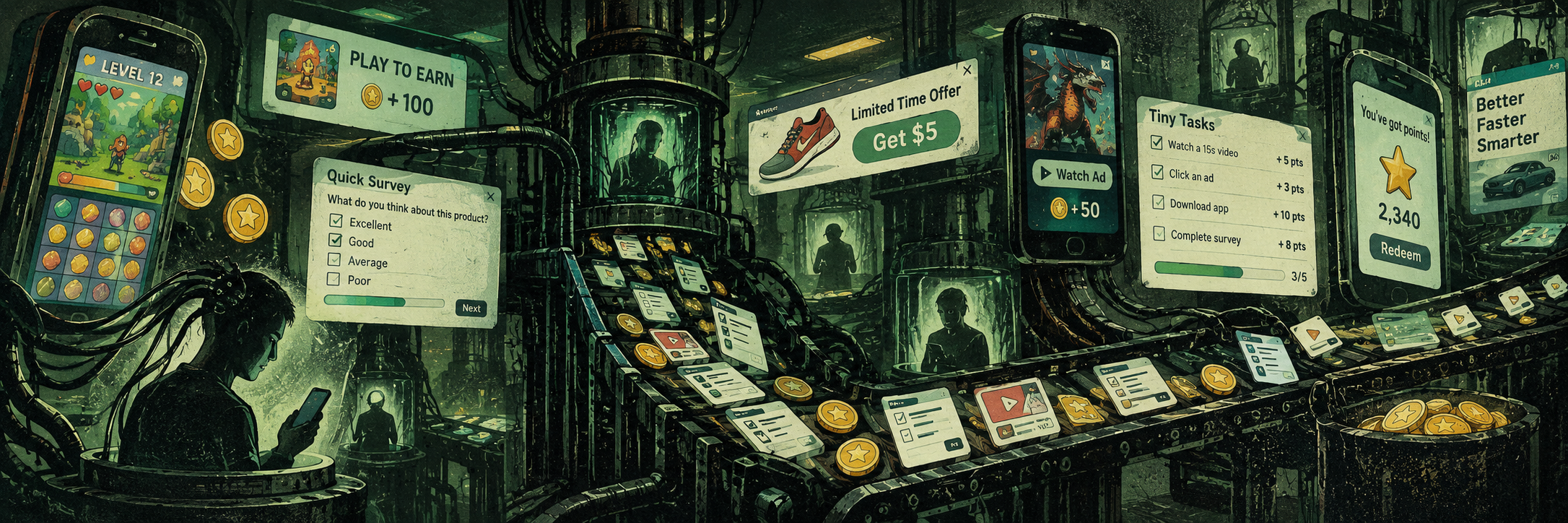
Using Broke People For Games, Surveys & Ads
Signing Up For The Matrix
Posted by Charlie Recksieck
on 2026-09-24
I've run into this by playing some phone games especially as an ineffective insomnia cure. Game ads for more games, which feature more ads, or surveys about games, or surveys about ads, with ads about surveys. You get the idea.
Once I even did a little bit of investigating, it's kind of making me sick, how technology has made it so easy to turn economic desperation into a business model.
None of these little tasks individually look like a job. But collectively, the people who perform them become a labor force.
The internet has figured out how to monetize people’s spare time - especially the spare time of people who can’t afford not to monetize it.
Why Does Anyone Do This?
Because people need money. Duh.
$3 isn’t meaningful to someone financially comfortable; it can be meaningful to someone who’s broke. Companies know this and are apparently built on leveraging people with no assets other than free time.
The less attractive the task, the more you can target people who have fewer alternatives.
Just because people sign up for the tasks voluntarily doesn’t necessarily mean the economic relationship isn’t exploitative.
Welcome to the Matrix
Remember the key element to the 1999 film, The Matrix: An artificial superintelligence began harvesting humans as a cheap power source.
Think about how much of the internet quietly asks humans to perform tiny tasks and the comparisons get a little chilling.
- Click this.
- Identify this picture.
- Take this survey.
- Watch this ad.
- Play this game.
- Judge this AI response.
You’re supposedly the customer/user/player. But another way to look at it: you’re the unpaid or underpaid component inside their enterprise. Technology got way too good at disguising labor as entertainment.
It's gross, but yeah, the business model is clever.
Companies don’t need to hire employees. They create an app/website and let millions of people voluntarily compete for tiny payments.
A million people doing something for 25 cents can be a hell of a business.
Which Brings Me to Job Application Coding Tests
If you've ever looked for a programmer job then you’ve probably seen the "prove you can code" assignment.
Build this little application - Solve this problem - Spend an hour or three demonstrating your skills.
The company gets to evaluate hundreds of candidates. Think of the opportunity there for free coding because of economic need or even desperation for applicants.
Sure, usually the assignment is legitimate. But it's not difficult or even that cynical to fear that you’re essentially doing free work for the privilege of possibly being considered for a job.
There’s A Problem With The Results
If I were evaluating potential employees, I'd have a problem with some of this. Now give my coding test to ChatGPT/Copilot/Claude/etc. where AI produces code. Who or what exactly have I been evaluating, anyway?
Similarly, if I wanted to learn from survey results, my experiment is seriously impacted when the majority of people taking these surveys are doing it out of financial desperation which immediately skews my data.
Isn't It Ironic
Companies have spent years finding ways to extract cheap labor from people who need money. Now AI is becoming capable of performing the same kinds of repetitive cognitive tasks.
The people who were willing to work for pennies are competing with machines that work for way less than that.
The economic desperation that made microtasking possible may also be what makes it vulnerable to automation.
Now that tech has made labor cheaper, who benefits when the cost of that work approaches zero?
The company? YES, in the short term.
The customer? Nope.
The worker? Nope.
Conclusion
We've built an environment that figured out how to get millions of humans to voluntarily work inside it, even before the robots took over. That's chilling enough.
So here we are. We taught AI how to do the work.
Without a solution or a practical version of universal basic income, what do we do with our time without crawling into the matrix?
