
AI Can Build Your App - Should It?
More Code, More Clutter & Finding An Audience
Posted by Charlie Recksieck
on 2026-10-29
Guess what happened? That stupid mug app took off and eventually was generating more income than all of their medical apps.
Software success very often has little to do with its usefulness or importance.
AI Wants to Get Into the Software Business
So, AI can make apps now. Great.
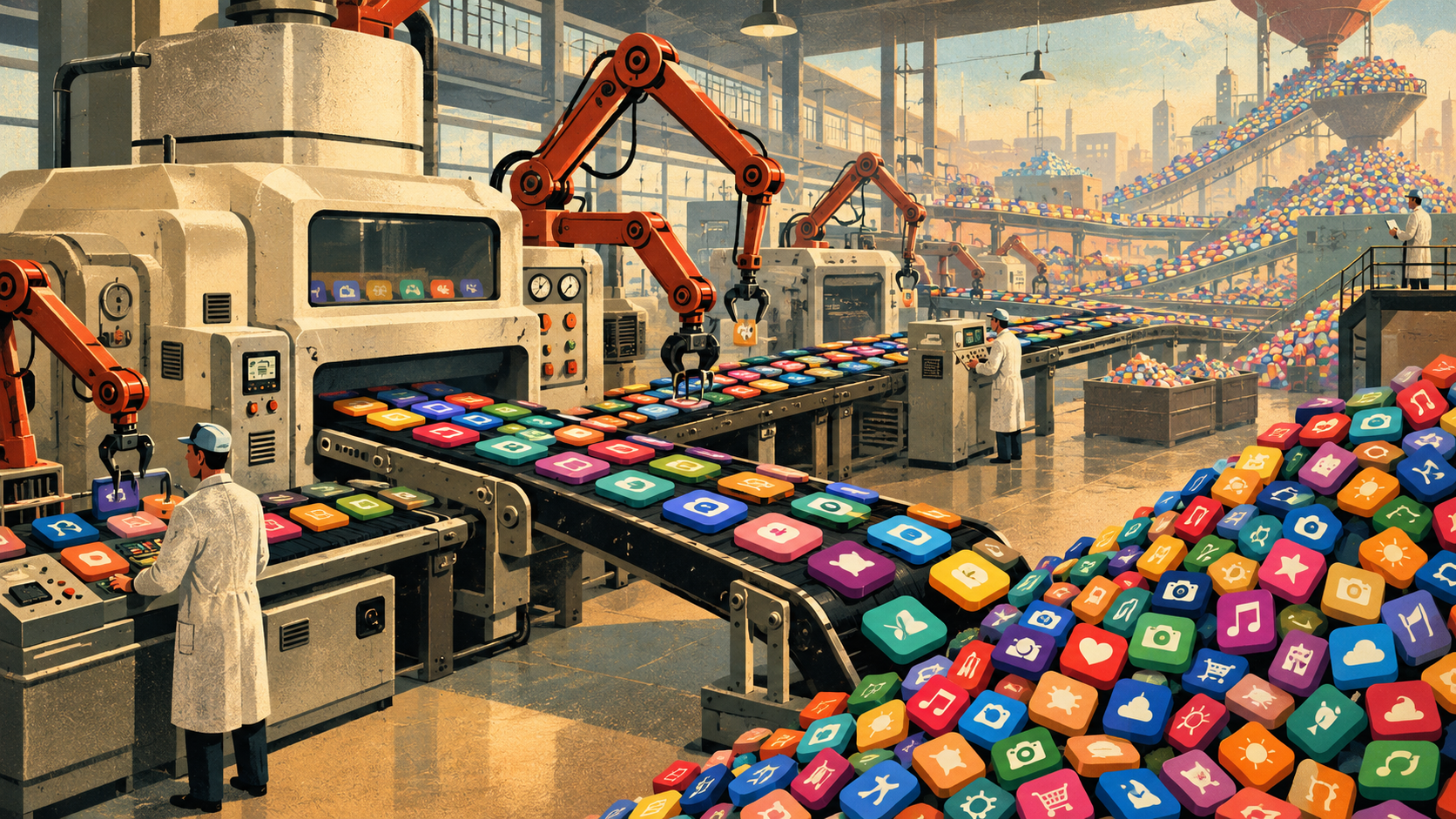
The software business is already overcrowded, and there was a glut of apps out there before AI even entered the picture. There are already endless apps, redundant services, subscriptions, productivity tools, and solutions on the market looking for problems or reasons for being.
Yet the feeling persists that every idea deserves to become a product.
AI has lowered the barrier to creating that half-baked idea and making it a reality. Anybody, not necessarily even software people, can turn an idle thought into an app.
Now we're going to find even more apps, programs and services out there flooding the market. But our actual needs for these apps haven't necessarily expanded.
What's going to happen when there's really no barrier to enter the software market?
The Great Idea Fallacy
Over the years, I can't tell you how many times clients, potential clients, and even friends have asked me or Plannedscape to build them an app or a website.
In my experience, the development is the easy part. Anything really can be built - it’s just a matter of how long it will take.
The clients imagine that once their great idea is online, people will naturally find it and want it. The early internet fostered the idea that you could put something out into the world, and it would become popular on its own merit
Getting attention, building an audience, and persuading people to use a product are much harder.
In my experience, marketing and promotion can require ten times the development budget. Getting your product heard IS the hard part of software.
The internet makes distribution possible, but it doesn’t make people care. Yes, AI can build a product for you, but it can't find you an audience.
Building vs. Maintaining
Making an app isn't the same skillset as maintaining an app. AI is a vibe coding phenomenon. It can produce a working first version in an amazingly short amount of time.
I've found that having AI help you fix code is another matter. It gets easily confused. It often insists on improving or rewriting parts of your codestream you didn't want it to touch. It keeps trying to innovate. And when the first fix it tries doesn't work, I’ve found that it panics and jumps straight to Plan B or even Plan C before Plan A is exhausted.
Once greenfield development is finished and you are lucky enough to have a great 1.0 version of your product, then the very unglamorous parts of the job just start. Security, bug fixes, updates, compatibility, support, and reliability are ongoing obligations - and things where AI doesn't quite excel.
When your product is buggy, it can get pretty dangerous. I mean if your app is an animated beer mug getting filled and it's buggy, sure - no harm, no foul.
But if a tool that almost works, or even works great 94% of the time, has some problems, it can end up wasting more time to fix the consequential bad output than the task it was supposed to solve.
In mission-critical settings, the consequences are bigger. The ease of producing software doesn’t make the consequences of using it disappear.
More Software Could Be Good
Every time I write about any new technology, I tend to sound like a wet blanket. That's not my intention; I don't want to be "old man yelling at clouds." My analytical tendency is to always be looking out for the unintended consequences of change.
That said, I have had a mostly great first-hand experience with AI code writing. It takes care of SO much dirty work. I haven't written my own authentication code modules in over 18 months, my AI intern can do that for me. It's written proof of concept code in a couple of hours for me that would have taken me a week without AI.
As long as people like me master how to master AI, it's a good thing. It makes mediocre programmers good and it makes good programmers great. Although it might end up making bad programmers even worse, who knows.
Coders can work much, much faster. And software "costs" are really not much other than time, so "faster" is "cheaper."
My utility company clients have always had a need for more mobile and tablet client apps for our complex desktop apps. When we've given a pricy estimate, those ideas were always dead-on-arrival. If they have all gotten faster and cheaper because of AI, great!
Also, the idea of AI being able to take an idea and really get most of the way to an app, then individuals and small businesses can get specialized tools that weren’t previously economical to build.
You can build all kinds of niche apps at such a low cost that it hardly matters if there's an audience for it. Let's say I wanted that stupid beer mug app to be green for St. Patrick's Day. It would be very doable for me to reverse engineer it and just make my own.
This cheapness is fantastic for building things for yourself. Building a public product for an increasingly crowded public marketplace, not so much.
More software isn’t inherently bad. The question is what kind of software we’re creating, and for whom.
Calculate the Costs
Again, the cost of software product creation may fall dramatically. At the same time, the costs of reliability, maintenance, marketing, and earning people’s trust remain.
AI may make it easier to build something - but we already have plenty of software that nobody needs.
Just because you can build an app doesn’t mean anyone needs it - or that anyone will ever find it.
Or let’s put it this way: Just because you CAN build an app doesn't mean you SHOULD.
