
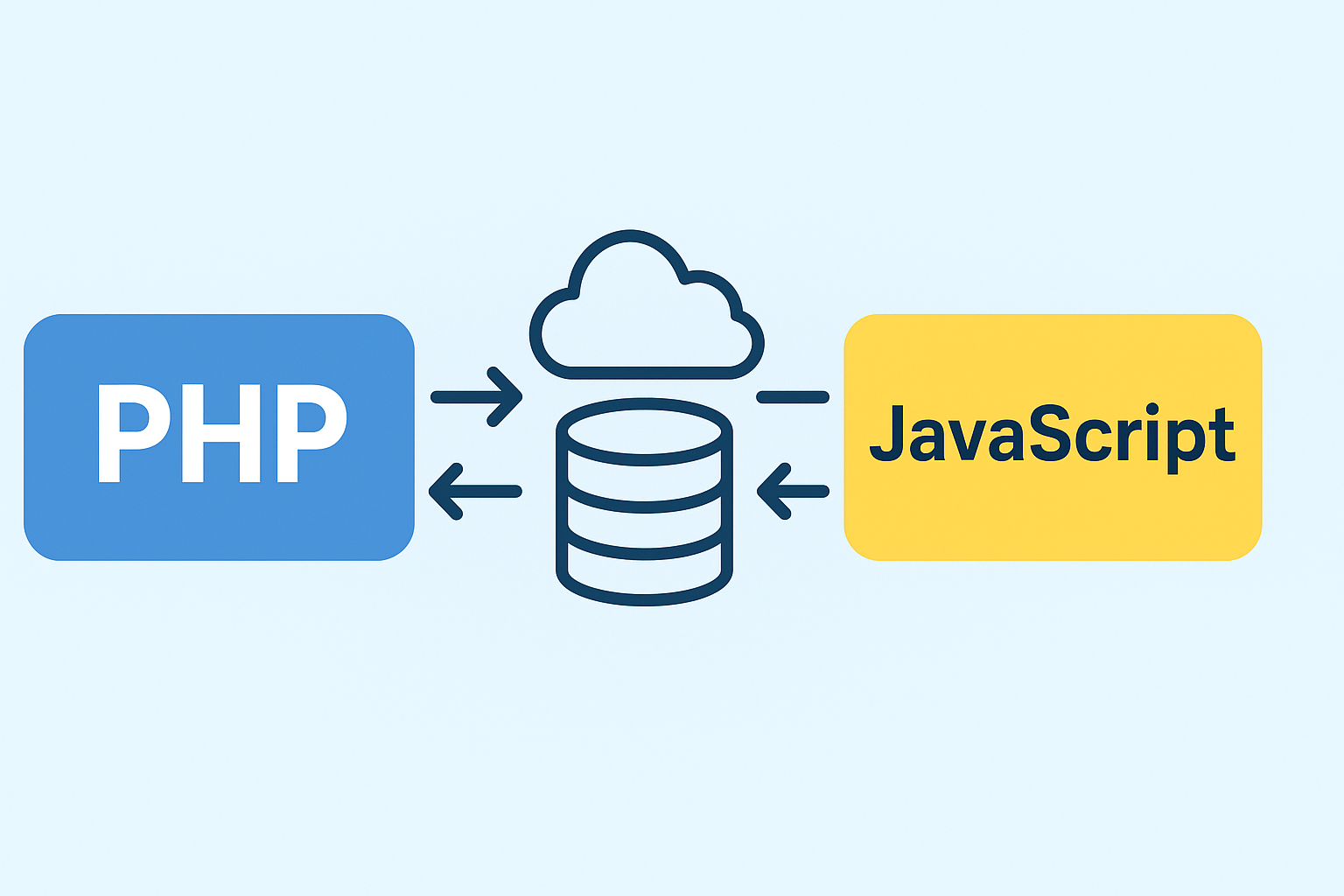
PHP and JavaScript
A Good Pairing?
Posted by Charlie Recksieck
on 2026-01-08
In a couple of cases, that's a moot question since I inherited these brownfield projects from a client who already had code with a previous developer.
Should you use this tech stack when you have a choice? When you do, what's the best way to move PHP info to/from JS?
Pros & Cons Of PHP Used With JavaScript
PHP is a server-side language, while JavaScript gets executed on the user side in the browser.
This can be a great thing because it makes for a clear separation of roles.
Server-side PHP is great for generating the page, reading from the backend database, and authentication.
JavaScript is better for UX stuff, validation, and interactivity.
The clearly separate roles make it relatively easy to decide what functions to put in what spots.
PHP works on just about every hosting platform. JavaScript runs in every browser. The mass support makes this a great combination.
PHP works on just about every hosting platform. JavaScript runs in every browser. The mass support makes this a great combination.
I've always been a supporter of PHP for how lightweight it is and the great performance when things are clean and well-done. Wikipedia is a great example.
But there can be a downside to using PHP with Javascript:
Switching Back And Forth - If your codestream bounces things back and forth between PHP and JS, then you're gonna have performance problems.
Duplicated Logic - If you have validation needs on both sides (PHP + JS), you're unnecessarily duplicating things, at best. Plus, your logic or rules can drift out of sync if coding in two different spots.
Harder to Build App-Like Experiences - Complex SPAs (single-page apps) are more awkward with PHP as compared to Node.js-based stacks. Web-based apps expect longer-living data and services; PHP starts fresh on each request.
Can Get Messy - If you're not careful, you can end up with: PHP generating HTML or AJAX endpoints scattered everywhere to communicate or save data from user input without regenerating the whole page.
Duplicated Logic - If you have validation needs on both sides (PHP + JS), you're unnecessarily duplicating things, at best. Plus, your logic or rules can drift out of sync if coding in two different spots.
Harder to Build App-Like Experiences - Complex SPAs (single-page apps) are more awkward with PHP as compared to Node.js-based stacks. Web-based apps expect longer-living data and services; PHP starts fresh on each request.
Can Get Messy - If you're not careful, you can end up with: PHP generating HTML or AJAX endpoints scattered everywhere to communicate or save data from user input without regenerating the whole page.
In summary, PHP + JavaScript is a Great Choice for
* Content-heavy websites
* SEO-first pages
* Small to mid-sized applications
* Teams with existing PHP skills
* SEO-first pages
* Small to mid-sized applications
* Teams with existing PHP skills
And Is Not Ideal For
* Real-time apps (chat, games)
* Large SPA dashboards
* Highly interactive SaaS products
* Real-time apps (chat, games)
* Large SPA dashboards
* Highly interactive SaaS products
Alternatives To PHP
If you're going to have JavaScript do user interaction work, then here are some other server-side options.
Node.js
* Same language front end and back end
* Lots of code out there to grab
* Excellent for APIs, real-time apps, and SaaS
* Easy to share code (validation, models) between client and server
* Great for teams already using JavaScript heavily
* Lots of code out there to grab
* Excellent for APIs, real-time apps, and SaaS
* Easy to share code (validation, models) between client and server
* Great for teams already using JavaScript heavily
Python (Django / FastAPI)
* Cleaner syntax
* So great for data & AI
* Best if your backend does a lot of data processing or AI
* So great for data & AI
* Best if your backend does a lot of data processing or AI
C# (.NET / ASP.NET Core)
* Very fast and scalable
* Excellent enterprise support
* Great for enterprise systems and high performance APIs
* Excellent enterprise support
* Great for enterprise systems and high performance APIs
Go
* Extremely fast and efficient
* Simple deployment (single binary)
* Great for microservices, high-traffic backends and cloud services
* Simple deployment (single binary)
* Great for microservices, high-traffic backends and cloud services
I'm about to be very reductive with these quick recommendations but based on your needs:
* Solo dev / startup / full-stack JS -- Node.js
* AI / data-heavy backend -- Python
* Enterprise or utility software -- C#
* High-performance services -- Go
* AI / data-heavy backend -- Python
* Enterprise or utility software -- C#
* High-performance services -- Go
Moving Data Between JS and PHP
Every programmer needs to be mindful of best ways to move data between JS and PHP.
For starters, don't be tempted to use hidden page elements like InnerDiv instances to hold data. Seems like a nice cheat because JS and PHP can interact with an InnerDiv. But it's a terrible idea. Trust me.
Other Practices To Avoid
* Echoing unescaped strings into JS
* Inline JS everywhere
* Assuming JS variables are "secure" (they aren't)
* Mixing HTML, PHP, and JS without structure
* Inline JS everywhere
* Assuming JS variables are "secure" (they aren't)
* Mixing HTML, PHP, and JS without structure
Again, I'm going to be a little reductive with these recommended methods without knowing exactly what you want to do. So, take these with a grain of salt.
Best Practices Between PHP & JS
* PHP --> JS: json_encode()
* JS --> PHP: fetch() + JSON
* Security: always validate on the PHP side
* JS --> PHP: fetch() + JSON
* Security: always validate on the PHP side
That said, you can get away with things like this for very simple values.
[script]
const username = PHP echo htmlspecialchars($username);
const userId = PHP echo (int)$userId;
[script]
const username = PHP echo htmlspecialchars($username);
const userId = PHP echo (int)$userId;
[script]
But I don't recommend it.
The End
That about covers it. Apologies to non-programmers who are usually the intended audience of this blog. I don't know why you would make it this far if that was the case.
For the rest of you developers, I hope this helped you make a decision about your website platform or suggested cleaner ways for your JS and PHP to talk to each other.
