
Choosing the Right Social Platform for Your Business
Stop Trying to Be Everywhere
Posted by Charlie Recksieck
on 2026-09-17
The better question isn’t "Which platforms are popular?" but "Where are my customers, and what do I want them to do?"
If you're killing it on one platform with decent engagement, that looks better than 5 C-minus accounts and performs better.
Start with the Business, Not the Platform
Ask yourself these questions to start:
Who you’re trying to reach
What you’re selling
Whether the product/service needs explanation
Whether your business is visual
Whether credibility or personality is the bigger selling point
Whether you’re trying to find customers or build an industry reputation
What you’re selling
Whether the product/service needs explanation
Whether your business is visual
Whether credibility or personality is the bigger selling point
Whether you’re trying to find customers or build an industry reputation
Each Platform Has Its Place
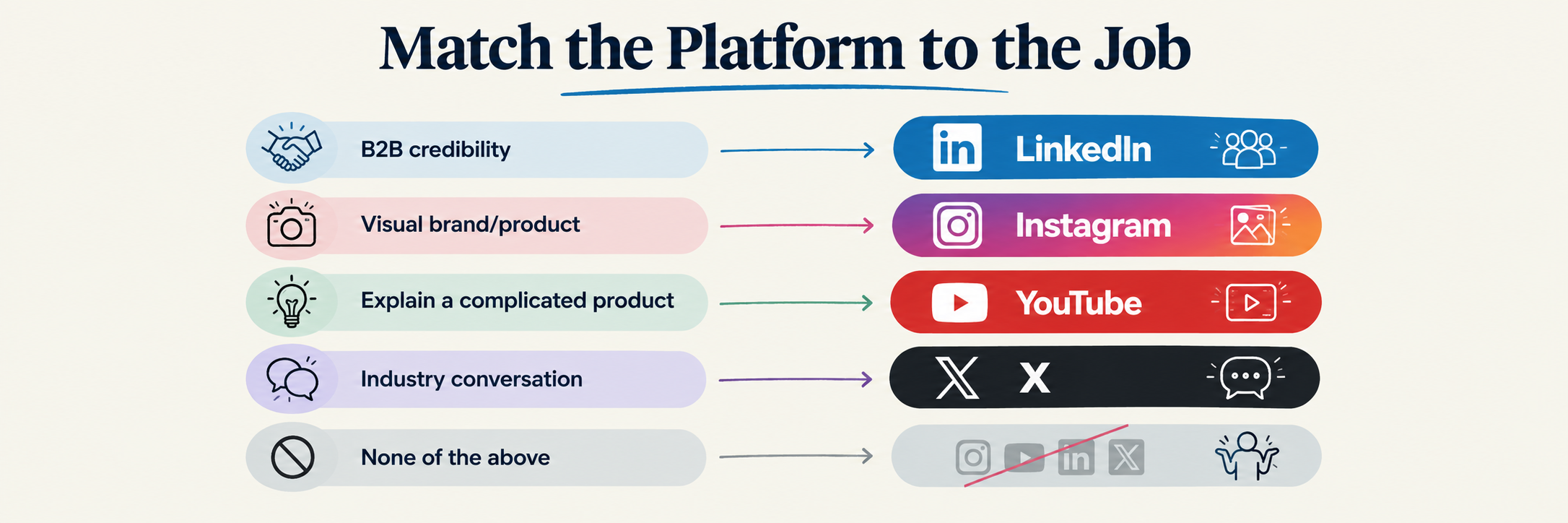
LinkedIn - Industry Credibility and B2B relationships
Useful for consultants, professional services, tech companies, recruiters, and B2B vendors.
Good place to demonstrate expertise rather than simply advertise.
Individual employees/founders can sometimes be more effective than a corporate account.
Good place to demonstrate expertise rather than simply advertise.
Individual employees/founders can sometimes be more effective than a corporate account.
Main Feature: You’re establishing "These people know what they’re doing."
Instagram - Visibility, Brand and Visual Identity
Natural fit for products, food, hospitality, entertainment, fashion, art, events, physical businesses, etc.
Strong for showing rather than explaining.
Personality and consistency matter.
Strong for showing rather than explaining.
Personality and consistency matter.
Main Feature: Let customers, colleagues and the world see some of your personality. Even though you're a business, people do connect with people.
YouTube - Explainers, Demonstrations and Searchable Knowledge
Especially valuable when customers need to see how something works.
Tutorials, demonstrations, product walkthroughs, and educational content.
Unlike many social posts, useful YouTube material can keep getting discovered months or years later.
As voice search dominates with a single uncredited answer and "the first page of Google" is less and less of a thing, YouTube is becoming the last real search engine for you to break through as an expert.
Be careful: This is WAY more time-consuming than posting on other social media; and it takes more time and decent production value to do it well.
Main Feature: YouTube is sneakily a search engine that you can't ignore.
Tutorials, demonstrations, product walkthroughs, and educational content.
Unlike many social posts, useful YouTube material can keep getting discovered months or years later.
As voice search dominates with a single uncredited answer and "the first page of Google" is less and less of a thing, YouTube is becoming the last real search engine for you to break through as an expert.
Be careful: This is WAY more time-consuming than posting on other social media; and it takes more time and decent production value to do it well.
Main Feature: YouTube is sneakily a search engine that you can't ignore.
X/Twitter or Threads - Conversation and Industry Commentary
Much more useful for some industries than others.
Particularly good when your business revolves around news, technology, politics, entertainment, sports, or other ongoing conversations.
Can establish a voice and connect directly with people in an industry.
But there’s no reason to be there just because everyone says you need a Twitter account.
Main Feature: Be an authoritative part of the conversation.
Particularly good when your business revolves around news, technology, politics, entertainment, sports, or other ongoing conversations.
Can establish a voice and connect directly with people in an industry.
But there’s no reason to be there just because everyone says you need a Twitter account.
Main Feature: Be an authoritative part of the conversation.
The Platform You Don’t Need
You don’t have to maintain every account. Your insurance agency doesn't need to be on Pinterest. Wrong audience, wrong fit.
An abandoned social account can look worse than no account. It's very similar to when a website features a News or Blog section and has nothing there for 4, 8 or 24 months. When I visit a site like that, I wonder "Are they still in business?" If I already know them, I might still follow up with a call or email. But if I'm casually browsing or looking for a service and find an abandoned account, I move on to the next one.
Sometimes your website, email list, Google presence, or a single social platform is enough. Think about it for your potential customer base and your industry. Where are the customers and what do they need to see?
Simple Rules For Getting Started
Pick one primary platform.
Define what you’re going to give people there.
Post just consistently enough to establish a presence.
Set a reasonable, sustainable schedule. If you feel like you don't have enough time, post SOMETHING once a week.
Use a social media calendar or pre-scheduler like Hootsuite or CoSchedule (or the platform's native pre-scheduled post features) to take 30 minutes to schedule 3 weeks of content at once.
See whether it actually produces the result you’re looking for.
Add another platform only when there’s a reason.
Define what you’re going to give people there.
Post just consistently enough to establish a presence.
Set a reasonable, sustainable schedule. If you feel like you don't have enough time, post SOMETHING once a week.
Use a social media calendar or pre-scheduler like Hootsuite or CoSchedule (or the platform's native pre-scheduled post features) to take 30 minutes to schedule 3 weeks of content at once.
See whether it actually produces the result you’re looking for.
Add another platform only when there’s a reason.
Conclusion
Let's face it; you need your to-do list to get smaller, not bigger. Social media can seem like an obligation. Keep it simple - post ANYTHING: a small observation, a photo of your dog, a pic of a couple of co-workers, a real-world example from the day's work.
Hand it off to somebody ambitious and young in your office.
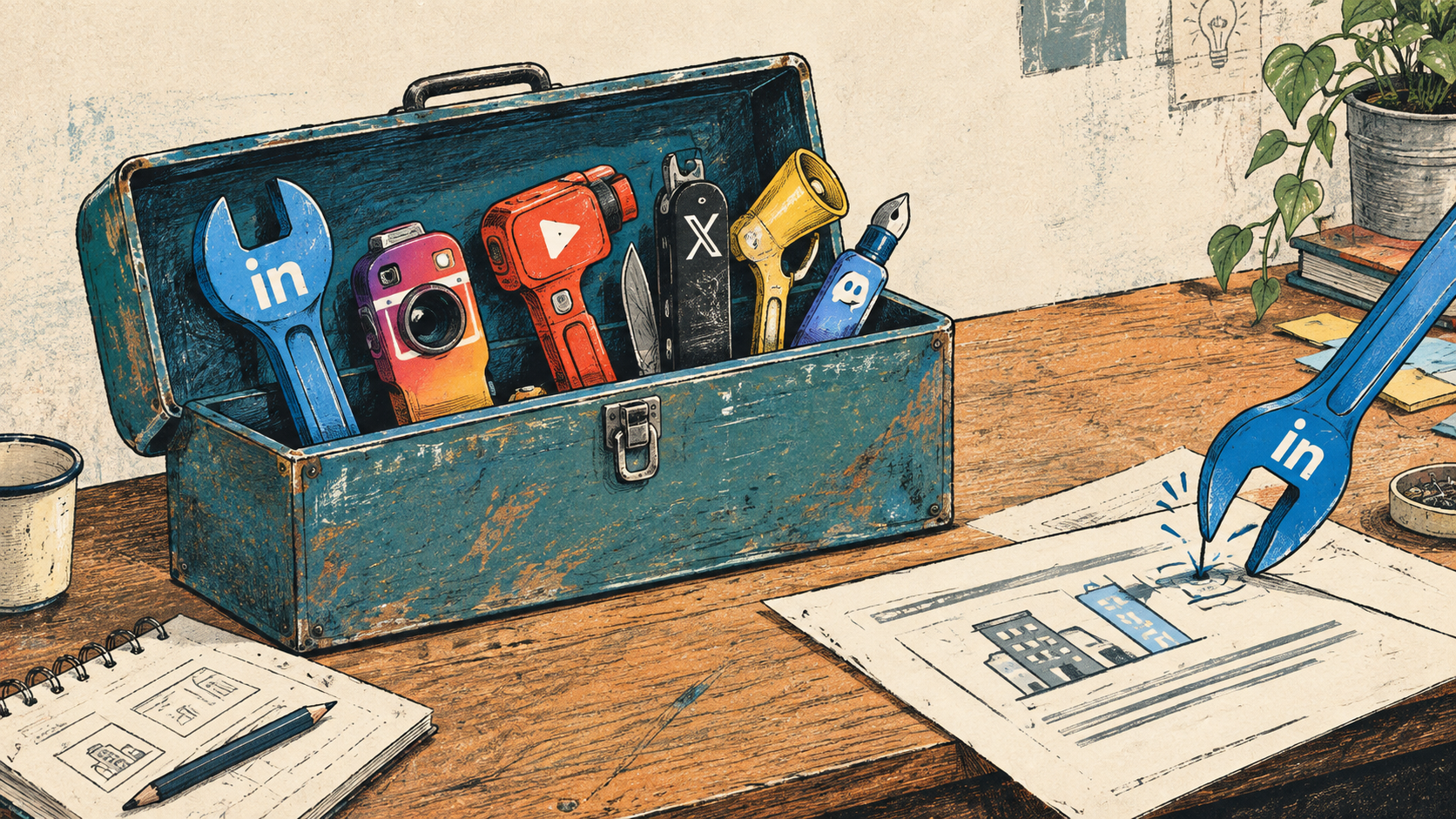
Social media shouldn't be a checklist. It's a tool. Choose the tool that fits - and the tool that gets you results. Just be aware that you don't always post on a Monday and get a new lead on a Tuesday. Sometimes that observation in January plants an idea in somebody's head and they send you an email in July.
That said, social media metrics are very measurable. If your posts get 2 likes on May 1 and start getting around 10 likes on August 15, keep going, that's progress that's helping your business.
